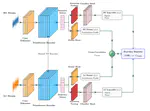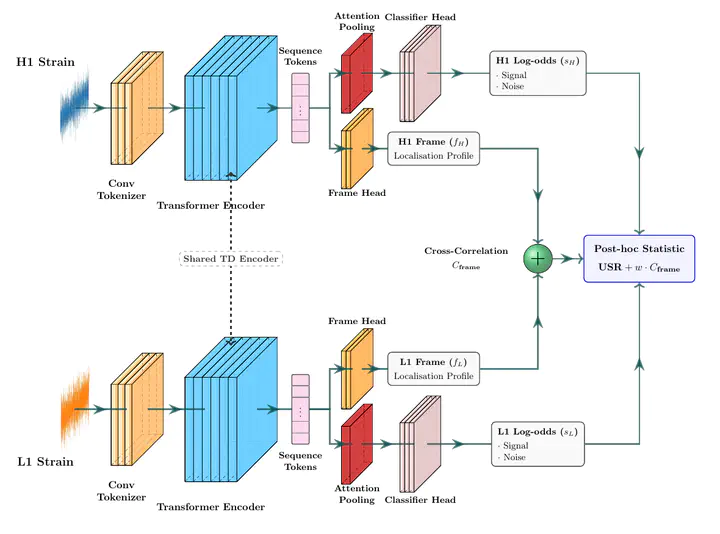
Castor is a compact transformer-based coincident search pipeline for binary black hole gravitational-wave signals in Advanced LIGO data. It uses a Siamese architecture: the H1 and L1 detector streams are analyzed independently with shared transformer weights, producing per-detector detection statistics and frame-level merger-localization profiles.
The key practical advantage is scalable background estimation. Because Castor caches single-detector outputs, time-slide false-alarm-rate estimates can be generated by recombining those outputs rather than rerunning the neural network for each shift. This makes the pipeline well suited for low-latency and offline searches where robust empirical backgrounds are essential.
 |
|---|
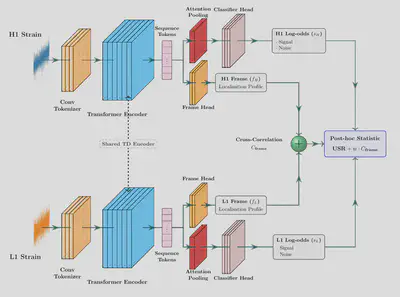
| Fig. 1: Architecture of Castor. Shared transformer encoders process H1 and L1 strain streams, attention and frame heads produce detector-level summaries, and a post-hoc statistic combines them into a coincident ranking score. |
Related papers:
Dr. Chayan Chatterjee
AI for New Messengers Postdoctoral Fellow
Dr. Chayan Chatterjee is the A.I. for New Messengers Postdoctoral Fellow at Vanderbilt University. His research focuses on applying machine learning, frontier AI and interpretable inference to gravitational waves and multimessenger astronomy.