A Fast and Scalable Transformer Pipeline for Binary Black Hole Detection
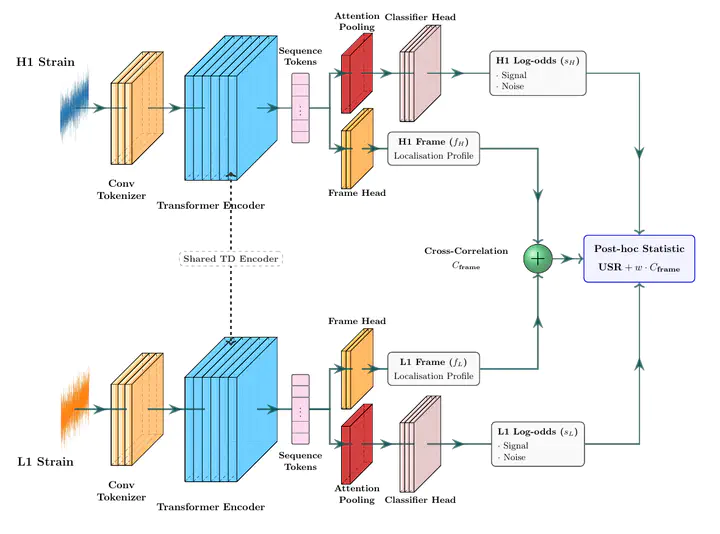 Architecture of Castor, a coincident Siamese transformer pipeline for binary black hole detection.
Abstract
With the projected increase in the detection rate of compact-binary coalescences in the coming decade, there is critical need to develop fast, robust, and scalable alternatives to matched filtering for gravitational-wave searches. Transformer models have revolutionized natural language and audio processing but their application to gravitational-wave astronomy is still largely unexplored. In this work, we introduce Castor, a transformer-based coincident search pipeline for detecting binary black hole gravitational-wave signals from Advanced LIGO detectors. One of the major features of our model is that it allows the false-alarm rate to be estimated via time slides cheaply without requiring repeated evaluations of the neural network. We evaluate Castor on datasets from the Machine-Learning Gravitational-Wave Search Challenge and on approximately five months of real O3b observing strain. Castor ranks among the most sensitive machine-learning pipelines, recovers the majority of confident GWTC-3 events within its training range, substantially outperforms GW-Whisper in sensitivity, and reduces the computational cost of background estimation by a factor of 20.
Castor, the Coincident Analysis Siamese TransfORmer, is designed for scalable binary black hole searches in Advanced LIGO data. Each detector stream is processed independently using shared transformer weights, and the resulting single-detector outputs are combined into a coincident statistic. This allows time-slide backgrounds to be generated from cached network outputs instead of rerunning the neural network for every slide.
 |
|---|
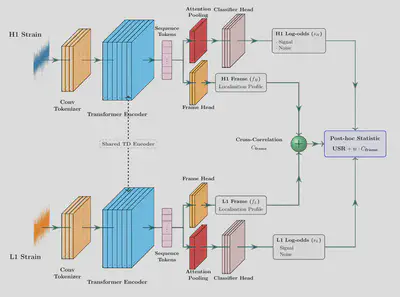
| Fig. 1: Castor tokenizes whitened H1 and L1 strain streams, processes them through shared transformer encoders, and combines single-detector log-odds and frame-localization profiles into a post-hoc coincident ranking statistic. |
Dr. Chayan Chatterjee
AI for New Messengers Postdoctoral Fellow
Dr. Chayan Chatterjee is the A.I. for New Messengers Postdoctoral Fellow at Vanderbilt University. His research focuses on applying machine learning, frontier AI and interpretable inference to gravitational waves and multimessenger astronomy.