 Multimessenger astronomy as a physics-governed training ground for frontier AI.
Abstract
Artificial intelligence (AI) is approaching the horizon of what can be learned from human-generated data just as multimessenger astronomy (MMA) enters a data-surge era in which conventional approaches are becoming a bottleneck in discovery. The convergence between MMA and AI is poised to transform both domains. Over the coming decade, MMA will turn rare cosmic events into continuous, multi-petabyte data streams that collectively sample physics across all four fundamental interactions. Unlike typical AI datasets, this deluge is governed by known physical laws and offers a unique hierarchy of simulability. MMA therefore provides a controlled environment where AI systems must distinguish instrumental noise, simulation approximation and genuine physical novelty. Drawing on discussions from the 2025 workshop “Multimessenger Astronomy in the Era of Foundational AI” at Vanderbilt University, we argue that MMA can serve as both a proving ground for trustworthy, physics-informed AI and a scientific domain where AI itself will become indispensable for future discoveries.
This Perspective grew out of the 2025 Vanderbilt workshop “Multimessenger Astronomy in the Era of Foundational AI” and frames multimessenger astronomy as a two-way opportunity: AI can help coordinate observations, accelerate inference and identify anomalies, while physically governed multimessenger data can help test whether frontier AI systems reason reliably about the natural world.
 |
|---|
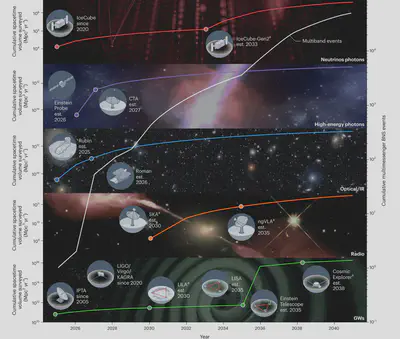
| Fig. 2: MMA’s data surge through 2041. The figure shows projected cumulative spacetime volume across messenger channels and the corresponding growth in observed binary neutron star multimessenger events. |
Dr. Chayan Chatterjee
AI for New Messengers Postdoctoral Fellow
Dr. Chayan Chatterjee is the A.I. for New Messengers Postdoctoral Fellow at Vanderbilt University. His research focuses on applying machine learning, frontier AI and interpretable inference to gravitational waves and multimessenger astronomy.